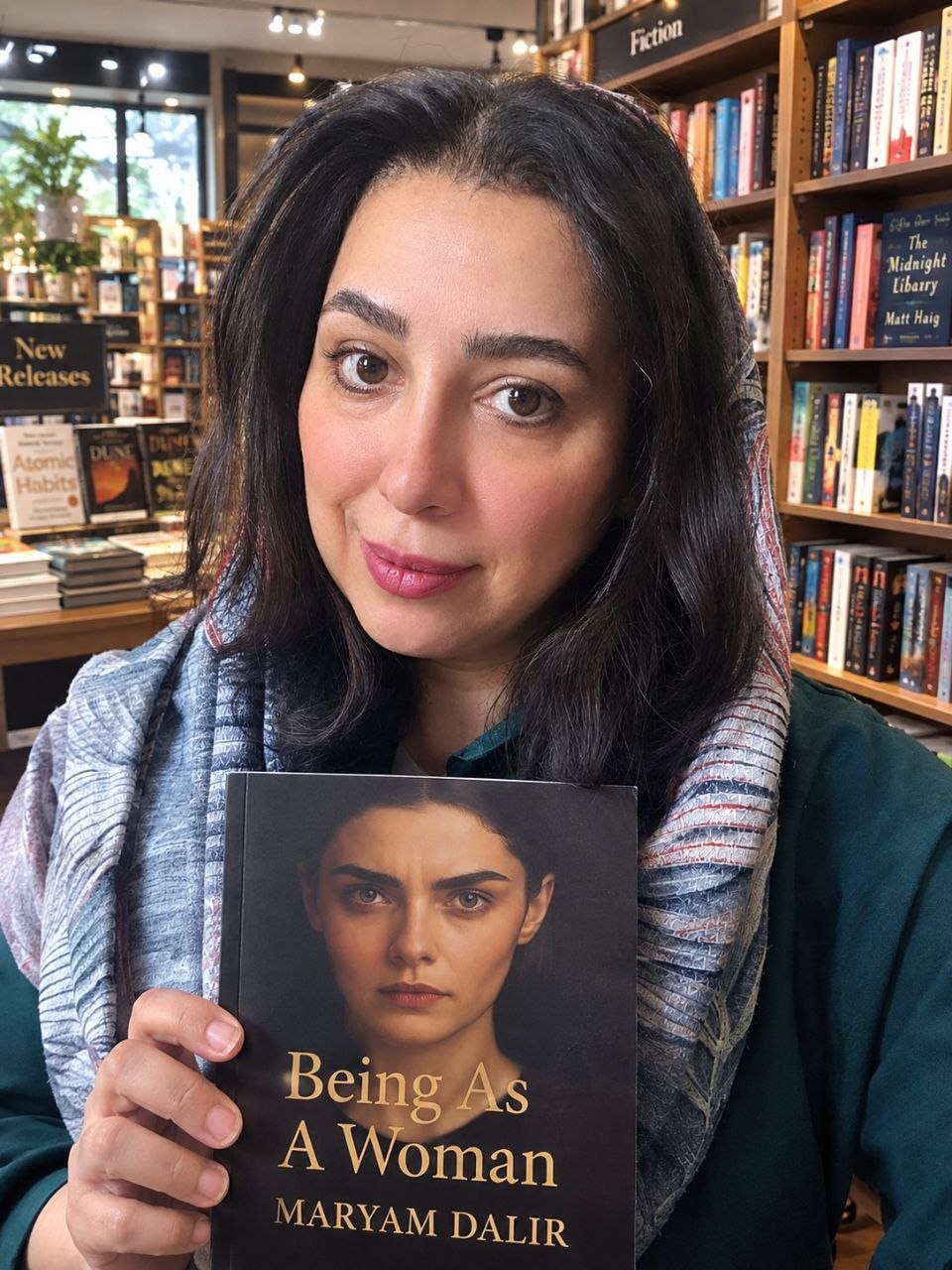
Saghar in Being As a Woman by Maryam Dalir
Saghar, the central character in Being As a Woman, is a portrait of an Eastern woman shaped by a patriarchal society where genuine equality between men and women is largely absent. From an early age, she grows up carrying a deep emotional wound.
Under a polygamous system, Saghar’s father abandons her and her mother for another woman and begins a new life with her. The experience deeply affects Saghar, leaving her with a lasting image of a man who chooses one woman while leaving another behind.
Perhaps that is why, when Saghar falls in love at the age of twenty-one with Kamran, the attractive, well-dressed, and wealthy boss of the large trading company where she has recently started working, her feelings are about far more than simply falling in love.
Saghar wants to be chosen.
She does everything she can to win Kamran over. She even prepares romantic breakfasts for him each morning, using her beauty, charm, and feminine appeal to capture his attention.
Eventually, she succeeds.
Kamran falls in love with her, too.
But just when Saghar believes she has finally gotten what she wanted, she discovers a truth that changes everything:
Kamran is married—and has a daughter who is about a year old.
Saghar knows she should walk away from his life.
But she doesn’t.
Instead, she decides to take revenge for the wound her father left in her heart by turning her anger against Kamran’s wife—the woman who, in Saghar’s eyes, now occupies the position her own mother once held.

This is where Saghar’s character becomes far more than that of a woman simply in love. She becomes a complex, contradictory, deeply psychological character.
She is a victim, but at one point, she also becomes someone capable of hurting another woman.
And perhaps this contradiction is one of the most important aspects of Saghar’s character.
Saghar: Neither Completely Good nor Completely Bad
Being As a Woman begins after Saghar and Kamran have separated and several years have passed.
Then, during an unexpected encounter, Kamran suddenly reenters Saghar’s life, bringing all the memories of the past rushing back.
But Saghar is no longer the young woman she once was.
She has changed over the years.
She no longer wants to be the third person in anyone else’s relationship. She doesn’t want to enter another woman’s life, and she doesn’t want to put herself in a position where love, self-respect, and peace of mind are once again taken from her.
So she tries to hide from Kamran.
But fate seems to have something else in store for her.
Saghar finds herself drawn into a new and turbulent chapter—one filled with difficult choices, old emotions, and experiences that force her to understand herself more deeply than ever before.
Saghar is not a flawless, completely good character.
But she isn’t evil, either.
She is a morally gray character—a woman with weaknesses, selfish impulses, fears, emotional wounds, and, at times, behaviors she herself cannot easily justify.
Sometimes she lies.
Sometimes she pretends to be someone she is not.
Sometimes she makes choices the reader may disagree with.
And yet, these very qualities are what make her human and believable.
Because real people are rarely entirely good or entirely bad.
Sometimes we are wounded, and sometimes we wound others.
Sometimes we make mistakes.
Sometimes fear makes our decisions for us.
And sometimes, in our pursuit of what we believe will make us happy, we choose paths whose consequences we eventually have to face.
Saghar and Her Search for Happiness
Saghar wants to be happy.
But her path toward happiness is anything but simple.
She is determined to fight for the life she believes she deserves, even if she has to fight for it with everything she has. Along the way, she encounters experiences that reshape the way she sees love, dependence, independence, and her own identity as a woman
دیدگاهها